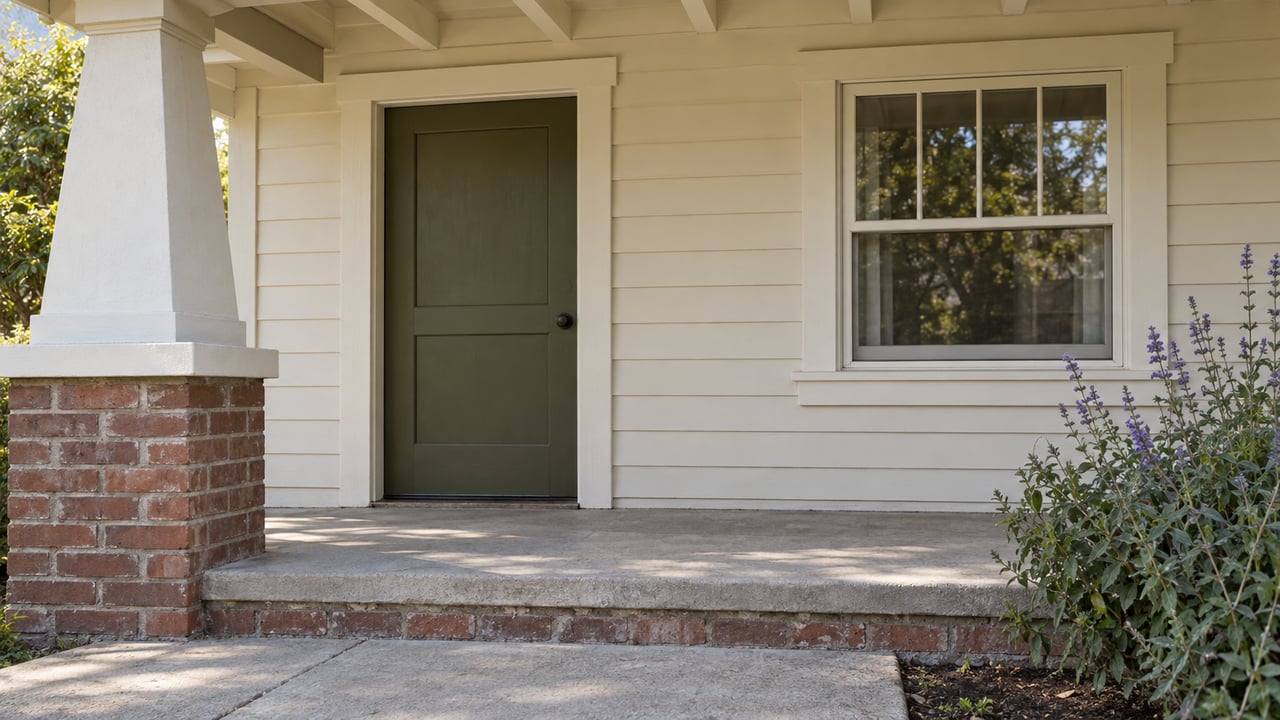
"Location. Quality. Tax savings." That's how one recent listing for a 1916 Craftsman near the Orange Circle pitched itself, promising that its historic Mills Act status meant substantial annual property tax savings for its next owner. Whether that promise holds depends on the home's status under the program.
The City of Orange's own historic preservation page states plainly that the city is not presently accepting Mills Act applications while the program is under review, and directs owners to watch city council agendas for updates. The Old Towne Preservation Association, the nonprofit that has tracked the district for decades, confirmed in a January 2026 member update that applications remain on hold with no date given for when they might resume. If you're shopping in Old Towne right now, that distinction between "this house already has a Mills Act contract" and "this house is Mills Act eligible" is worth more than almost any other line in the listing.
What the historic district actually asks of you
Old Towne Orange is the largest contiguous National Register historic district in California, encompassing more than 1,200 homes and buildings on streets radiating out from the Plaza, the circular traffic island the city built in the 1870s. The boundary runs roughly along Walnut, Cambridge, Almond, and Center streets, covering about a square mile of Craftsman bungalows, Victorians, and Spanish Revival houses.
Living inside that boundary comes with real design rules, not suggestions. Among the standards the city enforces on any street-visible exterior work:
- Vinyl windows are prohibited. Original windows are expected to be repaired and restored rather than replaced.
- Artificial turf is not allowed in parkways, front yards, or side yards visible from the street.
- Vinyl, chain link, and plastic fencing are prohibited, and front yard fencing is expected to include a planting strip between the fence and the sidewalk.
Small projects can often clear a Minor Design Review handled by staff. Larger ones, additions, new construction, most ADUs, go to the city's Design Review Committee for a full hearing. A 2026 contractor cost guide focused on Orange ADU projects put a number on what that adds: outside Old Towne, the standard state ministerial review runs 8 to 14 weeks. Inside the district, once DRC review is layered on top, the same permit path stretches to 14 to 22 weeks, with construction costs running 10 to 15 percent higher than an identical project a few blocks outside the boundary.
The tax break that was supposed to make it worth it
None of that friction is new, and none of it is unique to Orange among California's historic districts. What makes it tolerable, historically, is the Mills Act. The California Office of Historic Preservation says the Mills Act was enacted by the state in 1972 and that its contracts have a minimum ten-year term and are renewable.
Orange created its own Mills Act program in 1998, and more than 200 properties in the city have received the benefit since. It's a real, meaningful incentive, which is exactly why real estate copy leans on it so often when describing Old Towne inventory.
It is also exactly why the current freeze matters more than it would in a less design-restricted neighborhood. The whole logic of the historic district asks owners to accept slower permits, a real cost premium, and a short list of banned materials in exchange for character and a tax offset. Right now, only half of that trade is available to a new buyer. The design restrictions are fully in force. The tax offset is not accepting new applicants.
What's actually happening with the pause
The pause has also involved communication with existing Mills Act contract holders. In August 2025, the city sent a letter to existing Mills Act contract holders raising compliance questions. OTPA, working alongside the Orange Legacy Alliance, met with the city's Community Development Department afterward, and in its January 2026 update to members described the result plainly: city officials came to a shared understanding that the original letter was not an appropriate one to send to contract holders. A second, more targeted letter is expected to go specifically to contract holders the city currently considers out of compliance, and OTPA has continued pushing the city for clearer communication and due process around the whole review.
None of that has produced a reopening date. As of OTPA's most recent public update, new Mills Act applications in Orange remain on hold, full stop.
What the price data is doing while the tax program sits frozen
Set against this, the price behavior in Old Towne over the past year is worth a second look. Old Towne's median listing price per square foot ran at $715 in August 2026, down 4 percent from the same month a year earlier. Over the same window, the broader city of Orange was still posting gains, with Redfin recording a 5.2 percent increase in median sale price over the three months ending August 2026, to $1.2 million citywide, and homes selling in an average of 36 days. Orange Park Acres, a non-historic neighborhood a short drive from the Plaza with larger lots and none of the DRC's design constraints, posted a median of $1,326,000 in July 2026 on 37 days on market.
None of this proves the frozen Mills Act program is dragging on Old Towne values. The housing stock is different enough between these areas, smaller in-town lots against Orange Park Acres' rural parcels, that a clean comparison isn't really possible. But a buyer comparing a Craftsman near the Plaza against a similarly priced house in a neighborhood with no design review committee and no lapsed tax incentive is not comparing two identical trades. One of them currently comes with more restriction and less certainty about the offset than it did two years ago.
How to actually check before you write an offer
The good news is that this isn't a question you have to take on faith from a listing sheet. The Orange County Assessor's Special Properties Division, reachable at (714) 834-2727, can confirm whether a specific address carries an active Mills Act contract. If a listing mentions Mills Act status, that's the office that can verify it's real and already in place, not something the seller is hoping a future owner can apply for.
A short FAQ
Can I apply for a new Mills Act contract on an Old Towne home right now? No. The City of Orange's Mills Act program is currently not accepting new applications while under review, and no restart date has been announced as of the most recent public update from the city or from OTPA.
Does the freeze on new applications change the design review rules? No. The Design Review Committee process, the prohibited materials list, and the rest of the Historic Preservation Design Standards apply regardless of a property's Mills Act status.
If you're weighing an Old Towne bungalow against a house a few blocks outside the historic boundary, or you've found one that already carries a Mills Act contract and want a clear read on what that's actually worth before you write an offer, Emma Perez can walk through what you're really buying, permit timeline and all.
This article is general information, not legal, tax or financial advice. Consult a qualified professional about your situation.